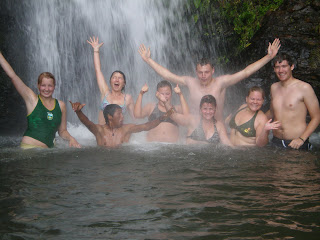
Before hitting us, try talking to us! That was the message the group of adolescents we work with wanted to communicate to their parents and to their community in general during an art exhibition they put on a few weeks ago. Using only recycled materials, they constructed an interactive exhibition based on the three main themes of the group: environmental protection, sexual and reproductive health, and violence prevention.
I was especially struck by the work they did related to violence, which is a social problem deeply entrenched in the culture. Here, most everyone see violence as a completely natural response to anger, “bad” behavior, sadness, and a host of other feelings and behaviors. Moreover, the Latin-America machismo culture prescribes a strict gender-role, purporting that “real men” are physically strong, don’t cry, exercise their power over others through domination and control, and don’t show emotions. This gender-role (combined with the submissive gender role of women) creates a climate in which violence (and especially violence towards women) is accepted as a natural.
Sometimes I scare myself when I realize how desensitized even I have become to the violence during my time here. The kids I work with have shown me bruises where their parents have beaten them, teenagers have told me stories about their alcoholic dads that abuse them and their mothers, and even those I somehow thought lived in families free of violence turn out to have bruises (either emotional or physical). I wish I could say that I was equally outraged each time I heard one of these stories. But the truth is that, though each story stings, there are too many to fully let the impact of each story sink in over you. And, honestly, what disturbs me most of all is the thought of all the stories that are not being told… The silently suffering, day in and day out, year in and year out.
Let’s not forget that these stories exist close to home too. In America, 1 in 4 women will experience violence in their lifetimes. In Norway too, supposedly one of the countries in the world with the greatest gender equality, women still bear the larger burden of violence in the home. And again, there are undoubtedly countless stories that are not being told here either…
If you are interested in learning more, click on the following links:
Amnesty International's campaign Stop Violence Against Women
UNIFEM - Violence Against Women
From Janne in Perú
Viser innlegg med etiketten La Restinga. Vis alle innlegg
Stories of violence
Janne puts down some thoughts about violence against women in Peru:
Dette innlegget handler om:
English,
Iquitos,
Janne Dale,
La Restinga,
Peru,
Sør-Amerika
Location:
Iquitos, Peru
Carnival in Iquitos
Janne blogs about Carnival celebrations in Iquitos:
The originally Brazilian festival of carnaval has taken in a life of its own here in Iquitos. After about a month of water balloon fights in the streets on Saturday and Sunday afternoons, the time finally came for the big celebration two weeks ago.
On Saturday, lots and lots of neighbors got together to dance, throw water at each other, and put up their humisha (a palm tree that they decorate with food, balloons, and gifts, and then place in the middle of the street). The day after, Sunday, is the biggest celebration. It basically consists of dancing, getting dirty (covering each other in mud, paint, and natural tints), and getting clean again (with water balloons and buckets of water being thrown over you ever other minute or so). It is definitely one of the best parties I have been to in my life -- children and adults all playing together, everyone dancing, and everybody (and especially adults) getting to act like children.
A radio station was hosting a party in the street, and that is where we spent most of the day Sunday. Incredibly liberating and fun having mud/water-fights with strangers, while dancing and enjoying the live music.
Read more: Janne in Perú
Dette innlegget handler om:
English,
Iquitos,
Janne Dale,
La Restinga,
Peru,
Sør-Amerika
Pirahnas in the pool
Janne shares a story from her work in Iquitos:
Yesterday, after the morning-program finished at La Restinga, some of the kids asked me to come with them and play on the boulevard (the street along the river, where the people congregate to wander at night). The summer vacation program has now officially started, and there are lots of new kids, so I had such a fantastic time getting to know and running around with this group of five heartbreakesrs. As the day got hotter, we went over to the big fountain with a small pool around it, and the kids screamed of joy as they threw off their shirts and jumped in. (I don't think it's normally allowed to play in the water, but the kids said that because there's a gringa (white woman) with them, the police wouldn't say anything. They were right. Sad, but true.)
Anyway, midway through a role game of tourists and sharks, one of the boys stopped in his tracks, and, a little paler than before, he turned to me and said: "Oh no.... Here comes the piranhas." I turned and looked, and recognized them immediately. Piranhas is the common way of referring to the rougher streetkids that live off of shining shoes, getting money from tourists, and stealing (not all streetkids steel, but those who do, or a suspected of doing so, are often referred to by this name). The leader of the gang, let's call him Jose, has been coming to La Restinga off and on for a long time, but is still living on the streets. His life could be so entirely different if he could choose La Restinga over the streets, but for an adrenaline-seeking group of young boys, leaving your friends on the streets in favor of a life of safety and rules is not always an easy thing.. Jose, especially, is really rough around the edges, and as he and his friends jumped into the pool, the dynamics changed instantaneously. The "piranhas" shoved the other kids away, grabbed the ball they had been playing with, and started their own game.
Read more: Janne in Perú
Dette innlegget handler om:
English,
Iquitos,
Janne Dale,
La Restinga,
Peru,
Sør-Amerika,
Utvalgte innlegg
Location:
Iquitos, Peru
From HIV to hope
Having a blast at the hospital with Luis and Julio
December 1st was the World AIDS day. Janne blogs about how this day went by in Iquitos:
Though everyone, regardless of age, religion, sexual orientation, gender, and lifestyle can be affected by HIV/AIDS, the fact is that persons in the sex industry (and in particular younger women) are much more vulnerable to becoming infected. Here in Iquitos, there are exceptionally high levels of child exploitation and prostitution, which contributes to the fact that Iquitos is the city with the second highest cases of HIV infections in Peru.
La Restinga's approach to this issue is broad and includes everything from education, to workshops, to theatre, to visual arts projects. This year, one of the highlights was taking part in a campaign against discrimination towards people living with HIV. All the kids got t-shirts that said VIH (HIV in spanish), and were given the chance to change that word into something like VIVO (I live), VIVIR (live), or VIDA (life). This was to send the message that getting HIV is not neccesarily a death sentence, and those who are infected are not just sick people, or case studies, but living human beings.
After everyone had made their own shirt, we went to the regional hospital, where we split into groups and asked the medical personal if they wanted to be part of the campaign. If they accepted, we put the VIH shirt on them and painted symbols and words on it while talking to them about how they could work to stop discrimination against persons with HIV/AIDS.
This was super interesting, because there is still a lot of fear within the medical community (some medical personell still insist on putting on gloves before examining a HIV patient, which is of course ludacris, since HIV cannot be spread through physical touch). The campaign turned out to be a huge success, and we had a ton of people coming up to us asking how they could get involved. When we ran out of t-shirts, some people (including patients at the hospital) came up to us insisting that we paint directly onto whatever clothes they were wearing [...]
Aside from this event, La Restinga has been working all throughout the month of November, dealing with issues of sexuality, gender roles and gender identity, abuse, trafficking, and STIs (sexually transmitted infections, including HIV/AIDS). I got the exciting challenge of co-teaching a weeklong workshop with an overview of all of these issues with some of the younger kids (10-13yrs), which was really interesting and but also daunting. The average age of first sexual intercourse in Iquitos is 14yrs (and in some isolated parts of the city it's as low as 12yrs), which is scary and heartbreaking (especially because sexual abuse definitely lowers the average). Given all the health risk associated with this, it's extremely important to start talking to the kids about these issues at an early age.
Les mer: Janne in Perú
Dette innlegget handler om:
English,
Iquitos,
Janne Dale,
La Restinga,
Peru,
Sør-Amerika
The La Restinga family
Pascual helping Betman, who has just learned how to read.
The days fly by in Iquitos. Janne blogs about how her and Elin's life in the La Restinga family:
Elin and I usually get up around 7.30 and arrive at La Restinga around 8.30 each morning to help out at Aula Movil. This is a homework help program (most of the kids go to school in the afternoon), but there are always other workshops and projects going on. Each month they choose a new theme to work with, and for the last month we have been working up towards the World AIDS Day on December 1st with the theme Sexuality and HIV-AIDS. I'll write more about this, and our celebration of December 1st in a later post.
The homework help and workshops usually lasts up until 11.30 or noon, when we all have lunch. There's a strict rule that everyone has to finish their food, which could seem odd because the portions are huge and there are kids and youth in all different sizes and ages, but this is usually not a problem since this is the only meal some of the kids get consistently every day.
After lunch, we slowly disperse (the kids go to school and I go back to the apartment). Two days a week, I return in the middle of the day to go with the team to Belen (a poverty stricken part of the city) where we have a separate project with at-risk kids and youth. Here we work as health promoters, and our workshops are centered around the prevention of sexual abuse and explotation, HIV-AIDS, and STIs, and promotion of healthy behavior, self-esteem, and personal hygiene.
Taking part of the planning and execution of this project is definitely some of the most demanding, but also the most rewarding work here. It is so fun to plan and be part of the planning process and figure out how we can best reach the kids, but really hard to put it into practice, because of countless challenges, including lack of attention (keeping a group of hyperactive kids interested for a full 2 hours is like a mission impossible), lack of attendance, lack of place to work (when we arrived on site last week, we were surprised to find that the roof of the building had been removed, which, in 100 degree heat made it impossible to work, so we had to cancel the next two sessions until we had a roof over our heads). Needless to say, I'm learning to be flexible.
After returning from Belen, we make dinner in the apartment, which is always an adventure. Elin and I love trying new things, and with a market full of unfamiliar vegetables, fishes, and fruits, we've had lots of exotic (though not always that tasty) dinners. Then, at around 7pm we return to La Restinga to help out or particitpate in different workshops (including juggleing classes, making t-shirts, capoeira, moviemaking, danceclasses, theatre, and much much more). The workshops usually last till around 9pm, but sometimes people keep hanging around late into the night telling stories and talking.
These late night talks have made for some of my best memories so far. I especially remember one of the first nights when a group of about 10 of us, including Puchin (who is one of the founders and basically the second father to all the kids) were gathered around the table eating a late night meal. Everyone was laughing and making fun of each other in such an intimate way. In that moment I realized that La Restinga is not charity, not a project, not a center, but simply family. And I am so thankful to feel part of it.
From Janne in Perú
Read more: Elin på tur:-) (Norwegian)
Dette innlegget handler om:
Elin på tur,
English,
Iquitos,
Janne Dale,
La Restinga,
Om La Restinga,
Peru,
Sør-Amerika
A hammock on the Amazon
The view from the hammock
Janne and Elin have been on a weekend trip to Requena, a neighbouring town to Iquitos. Since Iquitos has no road connection, that meant 15 hours on a boat, floating down the Amazon in a hammock. Janne blogs about her experiences:
It is 6pm, and I’m stretched out in my hammock, admiring the lush, green lanscape as we slowly float down the Amazon. The sun is slowly setting behind the majestic clouds, and the fresh breeze from the river alliviates the humidity of the air. Though the deck is crammed with people and their belongings (including a small cage with live chickens right behind me), I’m filled with a sense of awe for the vastness around me, knowing that I am surrounded by miles and miles and miles of largely untouched jungle.
In the hammock next the me, Elin is sitting upright, smiling and chatting with the young girl that’s brading her hair. Behind her, is another group of other curious kids surrounding us, one of them slowly tracing her fingers up and down my bare calfs (not sure if she is fascinated by my leghair or just wants to cuddle). The kids listen intently, and laugh from time to time, as they observe the spanish lesson playing out before them. Jenni, the 40-something woman in the hammoc next to me has made it her mission to teach me spanish in the course of the next few hours, and we move systematically through my notebook of vocabulary words.
”Re-co-no-cer,” she says slowly. Reconcer. ”To admit or aknowledge” according to my vocab list. Next she gives me an example of how to use it in a sentence: ”Tengo que reconocer que hice algo...” I quickly write it down. We continue with the next word: tacacho – the name of a typical Peruvian dish made of grilled platano (a non-sweet banana) mushed in pork grease. Sounds strange but is actually delicious. Jenni tells me that if I ever come back to Requena, she wants to show me how to make it. She even writes her phone number in my notebook, and says she means it seriously. I believe her. The sincerety and geniune warmth of the people here makes me feel at home, and as we curl up in our hammocks go to sleep a few hours later, it feels like I’m curling up to family.
Read more: Janne in Perú
Dette innlegget handler om:
English,
Iquitos,
Janne Dale,
La Restinga,
Peru,
Requena,
Sør-Amerika,
Utvalgte innlegg
Welcome to paradise
Elin and Janne have just arrived in Iquitos. They have taken a look around, and so far it feels like heaven. Janne writes:
Since Iquitos is famous for being the largest city in the world that cannot by reached by road, Elin and I had to leave Lima in a plane. After a short flight over the Amazonian jungle, we dove down to the small airport in Iquitos. I knew that the different regions in Peru (coast, highland, and jungle) were fairly distinct, both in landscape and culture, but I was still taken aback by how totally different it is up here.
[...]
Iquitos is completely surrounded by beautiful lush forests and though the river is pretty badly contaminated, the air is fresh. The landscape with the small straw huts along the roads, the houses built on stilts in the Belen neighboorhoos (more about that later), the small motocarros filling the streets (there are almost no cars here), and the bountiful open air markets is incredibly charming, and I feel almost giddy with excitement that I get to live and work here for the next six months.
Our first day was made extra special by Puri—a previous Hald student who works at La Restinga—who spent all of Saturday with us, showing us around town, helping us by some essentials for our apartmant (a fan, water, toilet paper, and other little things), and introduced us to some culinary specialties from la selva (the jungle). She also brought us to this beautiful getaway place, with a small pool, lots of hammocks, and small huts with views over the Belen neighborhood [...] What she didn't tell us, however, was that in one of the small tree huts, there is a cage with a big snake. Having inherited my dad's fear of snakes, I was not exactly thrilled about this [...] Thankfully, I now have half a year to learn to love these creatures...
Read more: Janne i Perú, Elin på tur:-) (Norwegian)
Dette innlegget handler om:
Elin på tur,
English,
Iquitos,
Janne Dale,
La Restinga,
Peru,
Sør-Amerika
12 years old and pregnant
Do you remember what you were worried about as a 6th grader? I seem to remember just moving out of my Barbie phase (a little late, I know) around that age. For the mamasitas (little mothers) we visited a few days ago, reality looks pretty different. Meet Gloria: a 13 year old girl from the local community who already has a 10 month old daughter, Cielo [...]. Most of the girls come from communities plagued by poverty, family violence, sexual violence, and drug abuse, and several of them have become pregnant through cases of incest of rape. Luckily, the Centro para Madres Adolescentes (Center for Adolescent Mothers) is giving these young women a chance to deliver their baby safely and break out of the cycle of poverty and abuse.
Our visit to the center was moving and disheartening, but also left me with the sense that these girls have hope for the future. The leader, Filomena, and the psychologist on staff gave us a presentation about the project, and afterwards we were shown around the center, got to see the Anacoda dance and a Peruvian polka performed by the girls, and got a few minutes to talk to them in the end.
The project currently has 15 adolescent girls (and 15 babies) living at the center, but every day kids from the community come there to take part of the vocational trainings and other types of education. The center offers vocational training in beautycare (see picture frm the classroom on the left), textiles, and bakery, so that the girls will be able to support themselves when they leave the center (usually after about a one year long stay). While there, the girls are given holistic support (including psychological care, counseling with their families, legal advice, health care, social services, etc). The goal is that the girls will have safe pregnancies, learn how to take care of themselves and their children, and be able to reintegrate into their families and communities with a new perspective and ambitions for their future.
[...]One of the things that struck me the most as we walked around the center was the writing on the wall above the soccerfield in the back of the center. In bright yellow letters it proclaimed Jesus' words that "los úlitimos seran los primeros" -- "the last shall be the first." These words take on new meaning when found in this setting where "the last" desperately need to know that they are not forgotten.
Les mer: Janne in Perú, Kristin i Peru (Norwegian), Thoughts from Bolivia, paa ville vegar (Norwegian)
Dette innlegget handler om:
Alalay La Paz,
Alalay Santa Cruz,
CEDETEP,
English,
Janne Dale,
Kristin,
La Restinga,
Lima,
Om CEDETEP,
Peru,
Svenn,
Sør-Amerika,
Vegard
Guinea pig and raw octopus
When you are abroad, the most obvious, and perhaps most challenging, differences probably concern food. Janne shares some of her experiences so far:
Living with a host family, we've gotten to eat a lot of traditional foods. The different regions in Peru, la costa (the coast), la sierra (the highlands), and la selva (the jungle) all have very distinct cultures and foods, but here in Lima you get to have a taste of it all. Luci, our housekeeper, is from the highlands, and the other day she prepared a specialty from her region: cuy -- also known as guinea pig. It tasted pretty good, but the legs were still intact, with claws and everything, which definitely startled me a bit at first. We've been served lots of other delicious (and less scary) foods, including papa a la Huancaina (sliced boiled potatoes covered in a cheesy, slightly spicy sauce served on top of lettuce) and chicha morada (a sweet beverage made from purple corn).
Yesterday, our group went out to a Cevicheria, a seafood restaurant where they serve the traditional Peruvian dish ceviche: raw seafood in a lime and onion sauce. I would be lying if said I didn't cringe a little bit at the sight of raw octupus tentacles in front of me, but after a few deep breaths I was ready to try it out. To my great surprise, it actually tasted really good! Granted, I think I'll still need to take a few more deep breath the next time I take on a plate of raw slabs of octupus, shrimp, and squid, but at least I'll know what to expect... :)
Read more: Janne in Perú, Kristin i Peru (Norwegian)
Dette innlegget handler om:
English,
Janne Dale,
Kristin,
La Restinga,
Lima,
Peru,
Sør-Amerika,
Tierra de niños
Changing Seasons
It is now time for the Act Nowers to leave for their practice places. Janne shares some reflections about leaving home: I've been home in Gjøvik for a few days now to pack and get ready to start the journey. As I arrived home, I was awestruck by the beautiful fall colors, bright and burning, draping the forests. At first, it made me think back to the majestic trees at St. Olaf in the fall and for a second I wanted nothing more than to go back there to the safety and comfort of my home on the hill. But then I was reminded by one of my favorite Donald Miller quotes:
"Everybody, every person has to leave, has to change like seasons, have to or they die. The seasons remind me that I must keep changing, and I want to change because it is God's way. I want to keep my sould fertile for the changes, so things keep getting born in me, so things keep dying when it's time for things to die. I want to keep walking away from the person I was a moment ago, because a mind was made to figure things out, not to read the same pages recurrently."
In a few hours I leave to go to Oslo, and before the sun rises tomorrow, I will be on my way to Peru. I have no idea what to expect -- all I know is that I'm leaving the comfortable and allowing myself to be changed by new surroundings and new challenges. Here we go...
Read more: Janne in Perú
Dette innlegget handler om:
English,
Janne Dale,
La Restinga,
Norge
Building bridges
One of the main ideas behind the Act Now programme is exchange of people and ideas between cultures. Anne-Therese has started a small drawing project, building bridges between children in Peru and children in Norway: 

Sometimes I actually do come up with a brilliant idea! I have a little sister in the kindergarden in Norway, and so I came to think about that it would be nice to make a little project between the kids there and the kids here. Because when I´m coming back I´m going to visit the kindergarden, and so the kids have something they can ask and talk about. And also the kids here always wonder about how is Norway, and what are the kids in Norway doing.The project was to draw:
What makes you happy?
What do you want to become when you are grown-up?
And so my mum and Elise brought all the dreams and visions from Norway to Iquitos, and I hope that my mums suitcase will be found very soon again, because in that suitcase are all the dreams and visions from the kids here!
See more pictures: Anne-Thereses blogg
Dette innlegget handler om:
Anne-Therese,
English,
Iquitos,
La Restinga,
Peru,
Sør-Amerika
Caught on film
Anne-Therese has been on Peruvian TV. Check out the show above.
Here is a link to a documentary/program about la Restinga! Wohoo! And at the final of the program I am even doing Capoeira :)It was sent through Napa, a tv-station for the whole of Peru, I think it's a channel for kids and youth. Everything is in spanish of course, but the whole text is written down below the video, so all of you who don't speak spanish... google-translate it :)
Click here!
From Anne-Thereses blogg
Dette innlegget handler om:
Anne-Therese,
English,
Iquitos,
La Restinga,
Peru,
Sør-Amerika
Carnival in Iquitos
February is the month for carnival. Anne-Therese blogs from Iquitos:
Two weeks ago we celebrated the carneval. Carneval here in Iquitos is something really big, and the big day (sunday 3rd of february this year) was prepared many days in advance. That means, the people were already throwing waterballoons at all the gringos two weeks in advance...
Still the waterballoons theese days were absolutely nothing compared to the big day sunday. I went with a friend of mine, Christian, to his place and spend most of the day over there. In his neighbourhood there were at least 7 “humishas”. A humisha is a kind of tree wich is decorated with all kinds of stuff - tubs where very popular! At around 6 o’ clock in the evening, after a lot of dancing, the humisha is taken down, and everyone can grab what they manage to grab of the decorations. (especially the t-shirts are very popular). This is kind of the big event of the day.
We started the day with sitting outside the house, like every peruvian does, and the kids were coming and going with water. After just 5 minutes I was soaked with water. I really mean S-O-A-K-E-D. I couldn’t walk anywhere, or the kids and the boys said “GRIIIIINGA!!!!!!!” and running after me with water. Crazy. The thing is that the boys soak the girls and the girls soak the boys (but when it comes to gringas, everyone can soak them...). It must have looked funny....a gringa running down the street, and a bunch of kids coming after with a lot of water. But of course, they catched me in the end...
Les mer: Anne-Thereses blogg
Dette innlegget handler om:
Anne-Therese,
English,
Iquitos,
La Restinga,
Peru,
Sør-Amerika
Infield-kurs og ferie i Sør-Amerika: Dødsveien, Isla del Sol og Machu Picchu
Det har vært både infield-kurs og ferietur for Act Nowerne i Sør-Amerika siden sist Lena forteller:
Anne Therese forteller videre:Dødsveien (Foto: Anne-Thereses blogg)
Etter noen timer på humpete vei (les: dødsveien) kom vi til Coroico hvor Infield skulle være. Godt å treffe de andre igjen, høre hvordan de hadde hatt det og dele både oppturer og nedturer. Dagen, i korte trekk, var fulle av visdom fra en vis lærer, god mat, sykkeltur, fransk mat (virkelig å anbefale), avslapping ved bassenget, mygg (av det verste slaget), fantastiske Act Nowere; ja rett og lett GODE MINNER! Da uka var ferdig var vi nok alle som en klare for å gi alt de siste månedene, og etter noen oppklaringer fra vår kjære Johann (Bolivianer og tidligere Act Nower i Norge) blir nok kulturelle misforståelser sjeldnere de neste månedene!Bading i foss under sykkelturen på infield (Foto: Therese i Peru)
Bolivianerne i gruppa måtte over grensa til Peru for å få enda 90 dager å boltre seg på, noe som endte i en stor gjeng som vendte nesa mot Titicaca og deretter Machu Picchu! En natt på Isla del Sol midt på Titicaca var fantastisk, det er fascinerende med en så stor innsjø så høyt oppe (3820 moh.), faktisk Sør Amerikas nest største.
Les mer: Lena - På vei til Bolivia
Så gikk turen videre til Machu Picchu. Johannes forteller:Isla del Sol (Foto: Therese i Peru)
Ferien startet med å igjen ta bussen, denne gangen til Cobacana, og videre med båt til Isla del Sol. Titicaca er svært. Veldig svært. Og veldig vakkert. Isla del sol er en øy som et fjell. Det går rett opp og så rett ned på den andre siden. Eneste transportmiddel er esler. Det ville si at vi var nødt til å gå opp sikkert 1000 trappetrinn for å komme oss til ungdomsherberget som lå på toppen. I tynn luft og med halvsprengte lunger tok det sin tid, men det var verdt det! Utsikten var fantastisk. Og på kvelden spiste vi et herlig måltid hjemme hos en lokal familie som brukte huset sitt som restaurant for å spe litt på inntektene. Fantastisk god mat.(Foto: Johannes på barnehjem)
Vi dro videre til Puno med buss, fikk 90 nye dager på grensa, og dro til de flytende gress øyene på Titicaca. (de som alle turister drar for å se) På forhånd var vi blitt fortalt at Uru-folket som bor der verken bruker sko eller sokker. Vi ankom i tåke og regn, og befolkningen hadde tydeligvis ikke sett turistbåten komme, så sannelig måtte de ikke bare løpe innom husene sine for å sette fra seg skoa…haha, det var jo rene turistattraksjonen, men vi fikk høre at det fantes noen øyer litt lenger ut som ikke ønsket kontakt med omverdenen. Får satse på at de lever barbent der borte.
Les mer:Anne Thereses blogg
Machu Picchu
At Machu Pichu er den best bevarte inkabyen kommer av at verken samtidens inkaer eller de senere conquestadorene visste om byen. Da den ble forlatt var det pga en epedemi som tok overtaket. De friske rømte og sperret veien for de syke som ble etterlatt til døden. Det var ikke før I 1910 at en amerikaner skulle ta på seg den ufortjente æren av å være den “første” til å oppdage byen som var blitt overgrodd av jungel gjennom de flere hundre årene den hadde stått tom. For de menneskene som bodde ved ruinene, ble deres verste mareritt til virkelighet: at den moderne verden skulle komme å forstyrre forfedrene ved å stjele sjelettene, krukkene og smykkene som lå igjen I ruinene. Disse står idag på museum I Amerika...
De to tusen sko-løse inkaene som bodde I Machu Pichu beveget seg nok ikke like mye som dagens 5000 turister som til daglig beveger seg mellom ruinene. Steinene blir slitte og deler av byen synker hver måned med 2 cm, noe som gjør at det er fare for at en del av byen skal rase ned I stupet som finnes på begge sider.. For å komme til ruinene før de ble overfylt av turister, valgte vi å dra tidlig kl 6 om morgenen. Tåke og regn preget de første par timene I machu Pichu, og jeg Anne therese, Hanna og Aggie brukte disse timene til å klatre opp på toppen bak Machu Pichu for å se utsikten derfra. Opp hit har inkaene av en eller annen grunn bygget en imponerende vei/trapp selv om det ikke finnes noen ruiner der.Inkasteiner (Foto: Anne-Thereses blogg)
Senere på dagen vandret vi mellom ruiner og en haug av newage folk som gikk og kjente på energien som lå I steinene og bukket før de gikk videre. Etter en uke på reisefot går turen hjemover I nattbuss. Når jeg lukker øynene ser jeg inkaruiner og når jeg sovner drømmer jeg om Urofolket som kommer I sivbåtene sine og synger og spiller for oss I beste harmoni, bare overskygget av uro-guttungen med frostsår I ansiktet som mismodig vinker til meg der jeg sitter I bussen.
Les mer: Johannes på barnehjem
Dette innlegget handler om:
Alalay La Paz,
Alalay Santa Cruz,
Anne-Therese,
Bolivia,
CEDETEP,
Copacabana,
Coroico,
Cusco,
Hanna,
Isla del Sol,
Johannes i Bolivia,
La Restinga,
Lena,
Machu Picchu,
Norsk,
Peru,
Puno,
Sør-Amerika,
Therese L. Holm
Jul i Iquitos
Det har vært jul på La Restinga også:
Logoen til La Restinga. Hjertet som har maattet taale mye smerte, men som etterhvert blir sydd sammen igjen.
Har blitt saa glad i det hjertet!
Jeg har hatt ei fantastisk julefeiring her i Iquitos. Den 22.desember hadde vi julemiddag for alle unger, ungdommer, voksne og ansatte som hører til La Restinga. Det dukket opp utrolig mange folk. Det var et herlig spetakkel uten like! Det ble servert en utsøkt julemiddag tilberedt av kokken selv, Erick, og til drikke var det min favoritt drikk ”maracuya” (pasjonsfrukt tror jeg det heter på norsk…). Jeg hjalp til med serveringa, men fikk satt meg ned til slutt jeg også.
Det ble jo selvsagt sagt at jeg skulle møte klokken 4 for å ordne til, for det var masse som skulle gjøres ble jeg fortalt (det hele skulle starte klokka 7). Siden det var en så viktig dag møtte jeg opp klokken 4….og typisk så er jeg og ei anna ei de eneste som dukker opp. Alle andre kommer i løpet av de neste to timene. Det er fascinerende å se hvor mye som faktisk blir ordnet på kort tid når man først kommer i gang, og alt er alltid klart når det begynner, men det er noen ganger litt uforståelig for meg hvorfor alt absolutt må gjøres i den aller siste liten… same same, but different, et herlig kaos med masse godt humør var nå i hvert fall resultatet :)
Les mer: Anne Thereses blogg
Dette innlegget handler om:
Iquitos,
La Restinga,
Norsk,
Peru,
Sør-Amerika
På ferie i Iquitos
Hanna og Therese var på besøk hos Anne Therese i Iquitos i nyttårshelga. Her deler Hanna noen av høydepunktene fra turen:
27. desember tok Therese og jeg turen til hjerte av Amazonas – Iquitos for å feire nyttår med actnow’er Anne Therese. Byen er uten veitilgang, så derfor tok vi turen med fly. Vi landa i noe som så ut som bare tett jungel. En vegg av varme møtte oss da vi gikk ut av flyet, Lima virker ganske så kaldt i forhold(tross at sommeren begynner å nærme seg her nå).
Noen høydepunkter fra turen:
-Å se prosjektet La Restinga Anne-Therese jobber på. Støttes også av Strømmestiftelsen. Det er et slags dagsenter for barn, med forskjellige aktiviteter, som skal hjelpe dem å vinkle hverdagen til noe positivt. Det bor også 5 gutter der, av forskjellige grunner. Likte veldig godt det jeg så av prosjektet.
-Da vi tre og to gutter fra La Restinga reise til bydelen Nanay, og dro på båttur på elva Nanay/Amazonas. Et litt useriøst spørsmål til Anne-Therese fra en av guttene om hun skulle bade, endte med at alle bada i elva fra båten i klær. Deilig å bade i varmen! For dere som lurer: Det var verken krokodiller eller pirajaer der vi bada.
-En dag dro vi til en veldig fattig og farlig del av byen helt nede ved elva; Belén. Menneskene som bor der bor på flytende hus som stiger og synker med elva. Elva bruker de til alt mulig; vaske klær, bada og å gå på do. Fra elva og opp til byen er det et stort marked, der finner man alt en trenger, fra mat til klær og musikk.
Les mer: Peru-Hanna:), Therese i Peru
Dette innlegget handler om:
Anne-Therese,
CEDETEP,
Hanna,
Iquitos,
La Restinga,
Norsk,
Peru,
Sør-Amerika,
Therese L. Holm
«Sola» in the jungle: World AIDS day, and more
Anne-Therese holds the fort in Iquitos alone now. Here she describes what went down in the jungle in December:
1st of december was the world day of AIDS and HIV (called SIDA and VIH in spanish). Of course La Restinga was an important participant. I was surprised that this day is so big here (in Norway I haven’t even heard about it). It looked a bit like the 17th of May actually. We were walking in this prosession with banners and flags and lots of people beeing happy and having fun. The difference was all the condoms walking around handing out condoms and folders.
[...]
At this day I participated in the puppet theatre (theatre with hands). I thought it was a good opportunity to learn spanish, even if the people were laughing of my strange or all wrong accent. I must admit that I don’t even understood all that I said... We had three plays, “The three small pigs and the bad woolf” (I was the condom), “Snowhite” (I was the bad whitch) and...ehh “rødhette” – the girl with the red jacket and the bad woolf. (I was her alcoholic friend and a nurse). If you wonder how at all a condom, an alcoholic friend and a nurse came into these stories...it is because that they are written to tell the kids about the AIDS. And so the bad whitch in snowhite died of AIDS, and the three small pigs won over the woolf because the condom gave them the tip of boiling hot water under the chimney. (the woolfs best friend of course was the HIV virus)....and so on.
Read more about life in Iquitos, Christmas preparations, and capoeira: Anne-Thereses blogg
Dette innlegget handler om:
Anne-Therese,
English,
Iquitos,
La Restinga,
Peru,
Sør-Amerika
En prins, ei heks, en kondom og et HIV-virus ...
Dette var noen av ingrediensene da Anne Therese og Helene var med barna fra La Restinga på utflukt i helga. Helene forteller:
Paa lordag var Anne-Therse og jeg med paa en utflukt med ungene paa La Restinga med maal for dagen aa laere om prevensjon og seksuelt overforbare sykdommer samt aa ha det sosialt, spille fotball og bade. Klokka 08.00 satt vi og rundt 50 andre oss i en buss og dro. Ungene spilte musikk, var ivrige etter aa bade og provde aa faa mest mulig oppmerksomhet ved aa pille meg i ora.
Det var flere ulike gruppeoppgaver samt smaa foredrag innimellom med info rundt tema. Det var ogsaa ett dukketeater og jeg maa si det var en ny opplevelse med tanke paa at figurene som var med i stykket var en dronning, en prins, ei prinsesse, ei heks, en trollmann, en kondom og ett HIV-virus. Men det er ingen tvil om at dette er utrolig nyttig laere og kulturen her er mye mer aapen rundt sex og unger utforsker i veldig tidlig alder. Det er ogsaa mye prostitusjon og informasjon kan vaere med paa aa gjore ungene mer bevisste.
Les mer: ~ Helene a la selva ~
Dette innlegget handler om:
Anne-Therese,
Helene,
Iquitos,
La Restinga,
Norsk,
Peru,
Sør-Amerika
¡Iquitos!
Helene and Anne-Therese have arrived in Iquitos. Anne-Therese shares her first impressions:
Photo: ~ Helene a la selva ~
Yes, now we are in Iquitos. After a some hours delayed flight, we finally landed on sunday, and Dino and Joel met us on the airport. The poor guys had been waiting for four hours in the rain... Hace mucho calor aqui!I(it´s hot!) Tiday it has been 37 degrees, and it is getting warmer every day ( I still don´t know why it´s getting hotter, I thought it was raintime, but I still haven´t seen any rain). Helene and I have some hard times getting used to the heath, even when we are sitting and not doing anything we are soaking wet of sweat....all the time.
[...]
We´ve been to La Resting asome days now, and I it´s a very nice project! The kids are asking a lot of things, and the y laugh a lot when I don´t understand anything. I hope my spanish will be better after some time! We have been picking garbidge for them to use in different project at La Restinga. It was impressing to see all the houses of wood, when the lake gets really big, they use a boats between the houses.
Read more: Anne-Thereses blogg
Dette innlegget handler om:
Anne-Therese,
English,
Helene,
Iquitos,
La Restinga,
Peru,
Sør-Amerika
Adios, Lima
Sør-Amerika-teamet er ferdige med språkkurset i Lima. Nå er tiden inne til å bryte opp, og reise til sine respektive praksissteder. Helene skriver:
etter 25 dager med iherdig tegning av palmer paa alt som finnes av papir og spansk boker skal jeg endelig dra til Iquitos. Tiden i Lima har bydd paa mange utfordringer for min del samtidig som jeg har blitt kjent med en helt fantastisk peruansk familie og faatt bo hos dem, blitt litt bedre kjent med prosjekter som Strommestiftelsen stotter og ogsaa blitt litt bedre i spansk. Hver onsdag har vi vaert og besokt ulike prosjekter og det har vaert veldig spennende. For eksempel gjor det inntrykk aa vaere med i en 1.klasse, hvor de fleste barna har blitt mishandlet paa ulike maater, aa ha tegne-konkuranse om barns rettigheter. Naa er jeg klar for Iquitos og la Restinga...
Les mer: ~ Helene a la selva ~
Dette innlegget handler om:
Helene,
La Restinga,
Lima,
Norsk,
Peru,
Sør-Amerika
Abonner på:
Innlegg (Atom)